What are the best materials for high-security exterior armored doors? The answer depends on threat level, climate, fire performance, weight, and certification. No material wins everywhere. That assumption fails.
This guide examines China’s top ten material choices for high-security armored doors, including galvanized steel, stainless steel, hardened steel, aluminum alloys, aramid fiber, UHMWPE, ceramic panels, mineral wool, reinforced glass, and corrosion-resistant coatings. Steel remains the practical foundation because it provides strong impact resistance and reliable frame integration. Stainless steel performs better near coastlines, where salt air quickly attacks untreated surfaces. Aramid and UHMWPE can reduce weight, but their performance depends heavily on correct layering and edge protection. Ceramic armor may improve ballistic resistance, yet it can crack under severe impact. Small details matter.
MarketsandMarkets’ Physical Security Market report projects growth from approximately USD 127 billion in 2024 to more than USD 170 billion by 2029. This expansion reflects rising investment in controlled entrances, critical infrastructure, and integrated access systems. UL 752, ASTM F1233, EN 1627, and fire-door standards provide useful testing references, but certification must match the complete door assembly. A strong leaf with a weak frame is not high security.
Security engineering expert Ross Anderson states, “Security is a system property.” His principle applies directly here. Hinges, locks, glazing, seals, anchors, and installation can undermine excellent materials. Buyers should request laboratory test evidence, corrosion data, fire ratings, and traceable manufacturing records from Chinese suppliers. Marketing language is not proof. Some specifications still need questioning. Real security is designed as a complete system, not selected from a material list.
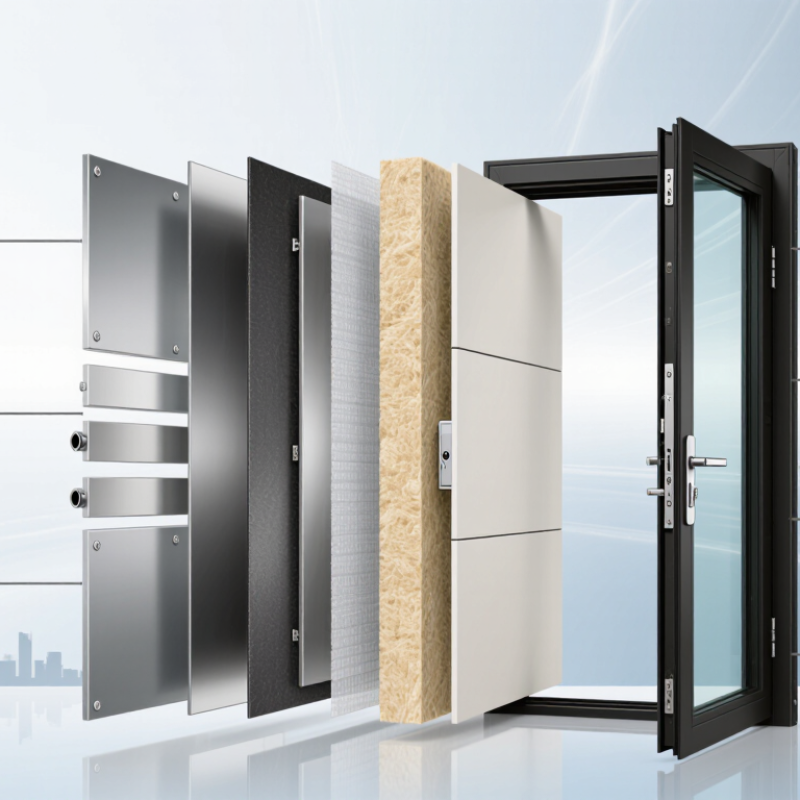
Material selection begins with verified performance, not thickness alone. High-strength steel remains common because it resists bending, drilling, and localized impact. However, its quality depends on yield strength, heat treatment, weld consistency, and corrosion protection. Stainless steel performs well in humid entrances, while galvanized steel usually offers a more economical barrier. Aluminum is lighter, but it often needs reinforced cores and stronger hardware.
The door leaf is only one part of the system. A suitable material must work with the frame, hinges, locks, glazing, and anchoring points. The EN 1627 resistance classification gives useful testing data: RC4 includes 10 minutes of defined tool attack time, while RC5 includes 15 minutes. These are laboratory attack times, not promises for every building. That distinction matters.
The UL 10C fire-door test also evaluates positive-pressure fire performance, showing why security and fire ratings must be assessed separately.
A hard truth.
Designers sometimes overvalue steel thickness. In field inspections, weak frames and poor hinge reinforcement often undermine expensive door leaves. I would specify tested assemblies, documented material certificates, and corrosion testing suited to the site. The ASTM F1233 security test method can help evaluate forced-entry resistance, but it does not replace project-specific testing. No material is perfect. The right choice balances strength, weight, fire behavior, maintenance, and installation accuracy.
China Top 10 Best Materials for High Security Armored Doors?
The Top 10 Materials Used in High-Security Armored Door Construction
High-security armored doors depend on material combinations, not one impressive metal. Galvanized steel forms a practical outer skin and resists moisture around entrances. Stainless steel adds corrosion resistance, especially in coastal or humid buildings. Alloy steel strengthens the door leaf, frame, and hinge reinforcement. Manganese steel can resist severe wear in high-contact areas. However, thicker steel may increase door weight and installation stress.
Aluminum is useful for lightweight trim and secondary panels, but it should not carry every security load. Aramid fiber can improve impact absorption inside a layered core. Fiberglass adds stiffness without excessive weight. Polycarbonate is suitable for protected vision panels when tested with the complete door assembly. Mineral wool supports fire resistance and reduces heat transfer within the cavity. It also helps control sound.
Reinforced concrete can strengthen frames or surrounding walls in specialized construction. The connection matters as much as the material. During site inspections, weak anchors and uneven floors often reduce real performance. A strong door can still fail at its hinges, locks, or frame gaps. Testing should cover forced-entry resistance, fire performance, corrosion, and repeated daily use. Material certificates are helpful, but installation records and independent testing deserve equal attention. No material solves every weakness.
| No. | Material | Typical Location in the Door | Key Security Function | Main Advantages | Important Limitations | Typical Density |
|---|---|---|---|---|---|---|
| 1 | Carbon Steel | Door skins, internal stiffeners, frames and lock reinforcements | Resists forced entry, deformation and impact | High strength, widely available, weldable and cost-effective | Can corrode without suitable coating; adds substantial weight | Approx. 7.85 g/cm³ |
| 2 | Hardened or Abrasion-Resistant Steel | Outer protective plates and localized attack-resistant zones | Improves resistance to cutting, drilling and repeated impact | Higher hardness than ordinary mild steel; strong wear resistance | More difficult to form and machine; may require specialized welding procedures | Approx. 7.80–7.85 g/cm³ |
| 3 | Stainless Steel | Exterior skins, frames, thresholds and corrosion-prone hardware areas | Provides structural protection while resisting moisture-related deterioration | Good corrosion resistance, durability and clean appearance | Generally more expensive and heavier than aluminum; machinability varies by grade | Approx. 7.70–8.00 g/cm³ |
| 4 | Aluminum Alloy | Frames, door skins, trim and lightweight structural components | Reduces door weight and supports corrosion-resistant construction | Low density, good corrosion resistance and easy fabrication | Lower hardness and stiffness than steel; usually needs reinforcement for high-security applications | Approx. 2.60–2.80 g/cm³ |
| 5 | Aramid Fiber Composite | Internal ballistic or impact-resistant panels | Absorbs and disperses impact energy with relatively low weight | High specific strength, lightweight and useful for layered constructions | Performance can decline with ultraviolet exposure, moisture or poor bonding; requires tested design | Approx. 1.40–1.45 g/cm³ |
| 6 | Ultra-High-Molecular-Weight Polyethylene Composite | Lightweight protective inserts and internal reinforcement panels | Provides high specific energy absorption in properly engineered laminates | Very low density and strong resistance to many chemicals | Sensitive to elevated temperatures and requires controlled lamination and edge protection | Approx. 0.93–0.97 g/cm³ |
| 7 | Ballistic Ceramic | Specialized protective inserts behind an external facing layer | Hard surface can break or erode certain high-velocity projectiles | High hardness and effective protection at a lower weight than an equally thick steel plate in some designs | Brittle, vulnerable to mishandling and requires backing material and certified testing | Approx. 2.70–3.90 g/cm³ |
| 8 | Bullet-Resistant Laminated Glass | Vision panels, sidelights and observation windows | Maintains visibility while resisting penetration and hazardous spall when correctly laminated | Transparent, acoustically useful and available in multi-layer constructions | Heavy, thick and sensitive to edge damage; must be tested as a complete glazing assembly | Approx. 2.40–2.50 g/cm³ |
| 9 | Polycarbonate | Transparent protective layers and glazing backers | Improves impact resistance and helps retain fragments in laminated glazing | Much lighter than glass, high impact resistance and easy to fabricate | Can scratch, discolor under ultraviolet exposure and soften at high temperatures | Approx. 1.20 g/cm³ |
| 10 | Reinforced Concrete or Cementitious Core | Specialty heavy-duty door cores and surrounding structural frames | Adds mass, stiffness, fire resistance and resistance to blunt impact | Noncombustible, rigid and effective for robust fixed installations | Very heavy, difficult to hinge and unsuitable for many standard door openings | Approx. 2.20–2.40 g/cm³ |
Note: Material performance depends on thickness, geometry, joining methods, protective coatings, hardware, installation quality and independent testing of the complete door assembly. Density values are approximate typical ranges.
High-security doors often combine ten materials, not one. Galvanized steel resists corrosion and supports the outer shell. Stainless steel improves durability in humid corridors. Hardened armor steel slows cutting and prying. Aluminum reduces weight, but needs steel reinforcement. Titanium offers excellent strength, though its cost limits practical use. Ceramic panels can disrupt impact energy. Aramid fiber adds lightweight layered protection. Mineral wool improves fire insulation. Gypsum boards reduce heat transfer inside the leaf. Intumescent seals expand around the frame during fire exposure.
Material thickness is only part of the answer. EN 1627 rates forced-entry resistance from RC1 to RC6, with higher classes requiring stronger tools and longer test exposure. A weak frame can defeat an expensive door leaf. Field inspections often reveal gaps around hinges, locks, and thresholds. That detail is easy to overlook. Fire performance also needs testing. The European EN 1634-1 method measures integrity and insulation, while NFPA’s Fire Loss in the United States During 2023 estimated over 1.5 million U.S. fires. Proper mineral wool density, sealed joints, and certified hardware matter.
Tips: Match the material stack to the threat, climate, and fire rating. Inspect welds and frame anchors, not just surface steel. Avoid choosing titanium or ceramic without verified test evidence. No material is perfect. Weight, corrosion, heat transfer, and maintenance still require careful review.
When comparing armored door materials, match the material to the actual security requirement. A security door is not judged by thickness alone. Its frame, hinges, lock housing, and installation matter equally.
For high forced-entry resistance, galvanized steel and carbon steel provide strong, practical protection. Stainless steel performs well in humid coastal areas and resists corrosion. Aluminum is lighter, but usually needs internal reinforcement. Wrought iron offers a rigid decorative structure, though it can require regular maintenance.
Reinforced glass improves visibility, but it must be part of a tested door assembly. Fiberglass resists moisture and dents. Composite panels can balance weight and strength. Hardwood adds warmth, while mineral-core board supports fire-conscious designs. Each choice has limits.
A common mistake is choosing the heaviest material automatically. Heavy doors can strain hinges and weaken installation points. In real assessments, I would check the wall structure, door opening, climate, fire needs, and daily traffic before selecting materials. Testing evidence should come from qualified laboratories, not only supplier claims.
Tips: Compare complete assemblies, not panels alone. Ask for test scope, impact conditions, corrosion data, and maintenance requirements. Inspect welds, seals, hinge protection, and frame anchoring. A cheaper material may work well in a dry, low-risk entrance, but fail in a busy coastal building. Reconsider assumptions after an on-site inspection.
Choosing materials for high-security armored doors requires more than maximum thickness. Long-term performance depends on corrosion resistance, impact strength, fire behavior, thermal movement, and repair access. Suitable options include carbon steel, galvanized steel, stainless steel, aluminum, hardened steel, laminated glass, polycarbonate, aramid fiber, UHMWPE, and ceramic panels. However, each material needs a complete door-system evaluation.
The NACE IMPACT study estimated global corrosion costs at about 3.4% of worldwide GDP. This figure makes surface protection a maintenance priority, not a cosmetic choice. Galvanized steel can reduce rust risk in humid areas, while stainless steel suits exposed entrances but costs more. Ceramic and fiber layers can improve ballistic resistance, yet damaged panels may require specialist replacement. ASTM F1233 testing and EN 1627 resistance classifications help compare forced-entry performance. Fire-rated assemblies should also follow applicable fire-door standards, because security materials alone do not guarantee fire protection.
Tips: Inspect hinges, seals, drainage holes, and fasteners every six months. Look for bubbling paint, white oxidation, uneven closing, and small glass delamination. A thicker plate is not automatically better. In practice, poorly sealed joints often fail before the core material. Specify replaceable components, compatible coatings, and documented maintenance intervals. I would also request salt-spray, cyclic-weathering, and repeated-impact evidence. Laboratory results can be useful, but real buildings are less predictable. Temperature swings, cleaning chemicals, and careless installation still deserve attention.
No. Strength also depends on yield strength, heat treatment, weld quality, and corrosion protection. A thick door can still fail. Weak frames or hinges may undermine it.
Stainless steel resists moisture and corrosion effectively. Galvanized steel provides a more economical barrier. Both still need suitable coatings, sealed joints, and regular inspection.
Aluminum reduces door weight and can simplify daily operation. However, it usually needs steel reinforcement, stronger hardware, or a reinforced core. Light does not mean weak, but design matters.
Mineral wool improves insulation inside the door leaf. Gypsum boards help reduce heat transfer. Intumescent seals expand around the frame during fire exposure. Fire performance requires certified testing, not assumptions.
No. Resistance classifications describe controlled laboratory attack conditions. For example, higher classes involve stronger tools and longer test exposure. Actual performance depends on walls, anchors, hinges, locks, and installation accuracy.
Not by itself. The frame, hinges, lock housing, glazing, threshold, and anchors must work together. Inspect the hinge side carefully. Small gaps can create serious weaknesses.
Compare complete assemblies, not panels alone. Review forced-entry tests, fire data, corrosion results, maintenance needs, and installation requirements. A lighter composite may suit a busy entrance better than heavy steel.
They may improve impact resistance or reduce weight, but verified test evidence is essential. Titanium can be expensive, while ceramic panels need careful design. I might overvalue advanced materials without project-specific evidence. Reconsider the choice after a site inspection.
Choosing the right material is essential for creating a high-security armored door that balances strength, fire resistance, durability, and daily usability. What are the best materials for high-security exterior armored doors? The answer depends on the required protection level, location, climate, and maintenance expectations. Common options include reinforced steel, stainless steel, galvanized steel, aluminum alloys, fire-resistant mineral cores, fiberglass composites, aramid fiber, ceramic layers, high-density wood composites, and corrosion-resistant hardware materials. Each contributes differently to structural stability, impact resistance, thermal protection, or forced-entry delay.
When comparing these materials, consider the door’s overall construction rather than focusing on one layer alone. A strong steel frame may improve resistance to deformation, while a mineral or ceramic core can enhance fire performance. Composite and lightweight materials may reduce operating weight without sacrificing useful protection. Long-term performance also depends on corrosion resistance, surface treatment, hinge quality, insulation, climate exposure, repair requirements, and routine maintenance. Selecting materials according to the building’s security needs ensures reliable protection, lasting performance, and practical operation.

CR Doors